Most funded startups in the UAE approach multi-channel advertising the same way: launch everywhere at once, split the budget five ways, and wait to see what sticks.
The result is predictable. Four mediocre channels instead of one that works. CAC climbing as campaigns fail to gather enough data. A performance team in reactive mode, chasing numbers on every platform simultaneously, optimizing nothing properly.
After managing paid media for funded startups across the UAE, KSA, and Kuwait — including brands scaling from AED 200K to AED 2M per month in ad spend, we have learned that the sequence in which you add channels matters as much as which channels you choose.
This is the framework we use at Gambra Digital. It is not a theory. It is what we have tested across real accounts in real MENA markets over the past three years.
Why Most MENA Startups Get Channel Sequencing Wrong
The pressure to scale fast in a funded startup is real. Series A founders have runway expectations. Boards want to see channel diversification. Marketing leads feel the weight of every untested platform as a missed opportunity.
The instinct is to move quickly and broadly. But in paid media, breadth before depth destroys performance.
Every channel requires a learning period. Meta's algorithm needs 50+ conversion events per week to exit the learning phase. Google Search needs enough impression data to understand which queries convert. TikTok needs creative testing cycles before the algorithm can optimize delivery.
When you split a AED 300K monthly budget across five channels at launch, none of them get enough data to learn. The result is five campaigns in permanent learning phase, generating inconsistent results, with no clear signal about what is actually working.
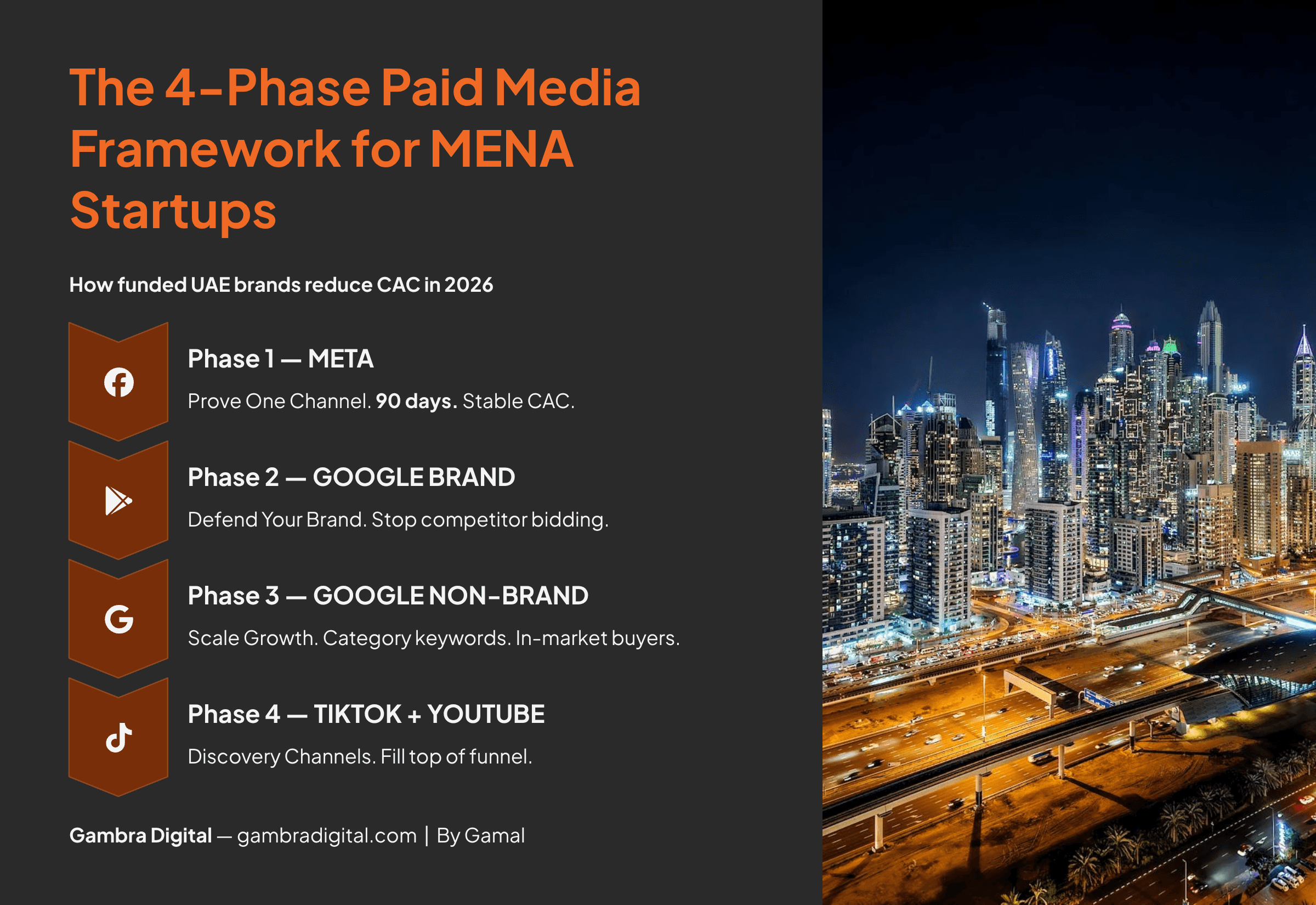
The fix is a phased approach: prove one channel, establish a CAC baseline, then layer in the next, with a specific job description for each channel in the funnel.
Phase 1: Prove One Channel First
The channel: Meta (Facebook and Instagram Ads)
Why Meta leads in MENA: Meta is the highest-reach, highest-intent paid social platform across UAE, KSA, and Kuwait. It offers the widest demographic coverage, the most mature optimization algorithms for e-commerce and lead generation, and the strongest creative testing infrastructure available in the region.
What to achieve before moving on:
A minimum of 90 days of consistent campaign data
A stable CAC within your target range (not just one good week)
At least 3 creative hypotheses tested with statistically meaningful results
A clear understanding of which audience segments convert, and at what cost
This phase is not about spending as much as possible. It is about proving that the channel is profitable at your target CAC. If you cannot make Meta work at AED 200K per month, adding Google or TikTok will not solve the problem. It will dilute it.
Common mistake: Moving to Phase 2 before the CAC baseline is stable. We see this constantly with funded startups who feel they should be on every platform. The pressure to diversify is understandable. But a CAC that climbs 40% in month three is a creative and structure problem, not a channel problem. Solve it before you scale.
Phase 2: Defend Your Brand on Google Search
The channel: Google Search (brand keywords only)
Why this comes before growth search: By the time your Meta campaigns have been running for 90+ days, a significant portion of your MENA market has heard of your brand. They are typing your name into Google. And if you are not bidding on your own brand keywords, your competitors are.
Brand keyword theft is one of the most common and most costly leaks in MENA paid media. A competitor bids on your brand name, appears above your organic listing, and intercepts a customer you have already paid to acquire through Meta. You paid the awareness cost. They capture the conversion.
What brand campaigns should do (beyond protection):
Brand campaigns in Google Search are a signal machine, not just a revenue protection tool. The data they generate is valuable for three reasons:
First, they reveal how your audience describes you. The search query variations your customers use to find you contain messaging intelligence you cannot get anywhere else. "Gambra Digital performance agency" tells you something. "Performance marketing agency for startups Dubai" tells you something different and more useful.
Second, they track competitor activity. When a competitor begins bidding on your brand name, your CPCs rise and impression share drops. You will see this in the data before you see it anywhere else. It is an early warning system for competitive pressure in your market.
Third, they protect the bottom of your funnel. The customers searching your brand name are your highest-intent audience. They have already been through your funnel. Losing them at the search stage, after all the upstream spend to create that awareness, is one of the most expensive mistakes in performance marketing.
Phase 3: Scale Non-Brand Search
The channel: Google Search (competitor and category keywords)
Once your brand campaigns are running efficiently and providing a stable signal, it is time to use Google Search as a growth engine.
Non-brand search targets three types of queries:
Category keywords: High-intent searches from buyers who know what they want but have not yet decided on a provider. "Performance marketing agency Dubai." "Paid media management UAE." "Facebook ads agency for startups." These buyers are in-market. They convert at a lower funnel position than social audiences.
Competitor keywords: Searches for competing agencies or services. These require careful management, the conversion rates are lower and the click costs are higher — but they put your brand in front of buyers who have explicitly signaled intent to purchase in your category.
Problem-based keywords: Searches describing the pain your product solves. "How to reduce CAC Meta ads UAE." "Why is my Google Ads ROAS dropping." "Performance marketing for Series A startup." These attract buyers earlier in the consideration phase but with high qualification, they are searching because they have a specific problem.
The combination of brand defense (Phase 2) and non-brand growth (Phase 3) creates a complete Google Search presence. You protect what you have earned and grow into new demand simultaneously.
Phase 4: Add Discovery Channels
The channels: TikTok, YouTube, Instagram (reach and consideration)
Phases 1 through 3 build a conversion engine. Meta converts. Google converts. Together, they should be generating a predictable, profitable CAC.
Phase 4 is where you build the top of the funnel that feeds that engine.
TikTok, YouTube, and Instagram Reels serve a different function than Meta prospecting or Google Search. They do not convert efficiently in isolation. Their job is reach and consideration, putting your brand in front of audiences who do not yet know they need what you offer.
Why the sequence matters: If you add TikTok or YouTube before your conversion engine is working, you will generate awareness that has nowhere to go. The audience will see your content, consider your brand, then search for you, and either find nothing (because your Search campaigns are not live) or be intercepted by a competitor (because your brand campaign is not protecting that traffic).
The discovery channels work best when they are feeding an existing conversion engine. Add them after Phases 1-3 are running profitably. Not before.
Platform-specific roles in MENA:
TikTok: Fastest-growing platform in GCC. Strong for younger demographics (18-34), impulse-adjacent categories, and DTC brands. Use for raw, authentic content, not high-production ads.
YouTube: Long-consideration purchase categories. Real estate, high-ticket fintech, SaaS. Pre-roll and mid-roll formats work well for educated B2C audiences.
Instagram Reels: Highest reach rate of any format at 30%+. The bridge between social awareness and Meta conversion campaigns. Cross-channel audiences between Reels and Meta perform significantly better than cold Meta audiences.
The Rule That Governs the Entire Framework
Before adding any channel, write one sentence that describes its specific job in your funnel.
Not "we should be on TikTok." Not "everyone is advertising on YouTube." One sentence that explains what this channel is supposed to do, at what stage of the buyer journey, and how you will know if it is working.
If you cannot write that sentence, you are not ready to add the channel. You are adding it because of pressure, not because of strategy. And in performance marketing, pressure-based decisions are expensive ones.
MENA-Specific Considerations
The framework above applies globally. But execution in MENA has specific nuances that change the priorities.
Seasonality: Ramadan, Eid, National Days, and DSF (Dubai Shopping Festival) create demand spikes that require phasing adjustments. Your budget allocation across channels should shift meaningfully in the 4-6 weeks leading into peak periods. Meta budgets typically increase 20-40% pre-Ramadan in e-commerce. Google brand CPCs spike as competitor activity increases. Plan for this.
Language: Arabic-language creative consistently outperforms English-only creative for lower-funnel conversion in KSA and segments of the UAE market. This is not a universal rule, it depends on category and demographic, but it should be tested in Phase 1, not as an afterthought.
Market sequencing: UAE first, then KSA, then Kuwait is the most common expansion sequence for funded MENA startups. Each market requires its own creative and CAC benchmarks. Do not apply UAE targets to KSA campaigns. The markets behave differently.
Conflict sensitivity: At the time of writing (April 2026), the Iran-UAE regional situation has created reduced advertiser competition across MENA platforms. CPMs are lower than Q4 2025. Brands maintaining spend are acquiring customers at a structural discount. This window will close when market sentiment stabilizes and budgets return to normal.
What This Looks Like in Practice
A B2B SaaS startup we onboarded in Q4 2025 came to us running Meta campaigns without a brand campaign, no Google presence, and planning a TikTok launch in month two.
We paused the TikTok plan. Built the Meta foundation for 90 days. Added Google brand campaigns in month two. Launched non-brand Google search in month three. By month four, their CAC was 31% lower than at the start of the engagement, not because of a single clever campaign, but because the channels were working together in the right sequence.
The 4-phase framework is not complicated. It requires patience in a business environment that rewards speed. But in performance marketing, the brands that build sequentially are the ones that scale profitably. The ones that launch everything at once are the ones sitting in board meetings explaining why they spent AED 1.2M and cannot explain what worked.