

If your app is scaling installs but revenue isn’t following, the issue is almost never:
Creatives
audiences
bidding strategy
It’s the invisible layer underneath them.
Post–iOS14, performance marketing for apps stopped being primarily a media discipline. It became an infrastructure discipline.
We worked with an app that looked healthy on the surface.
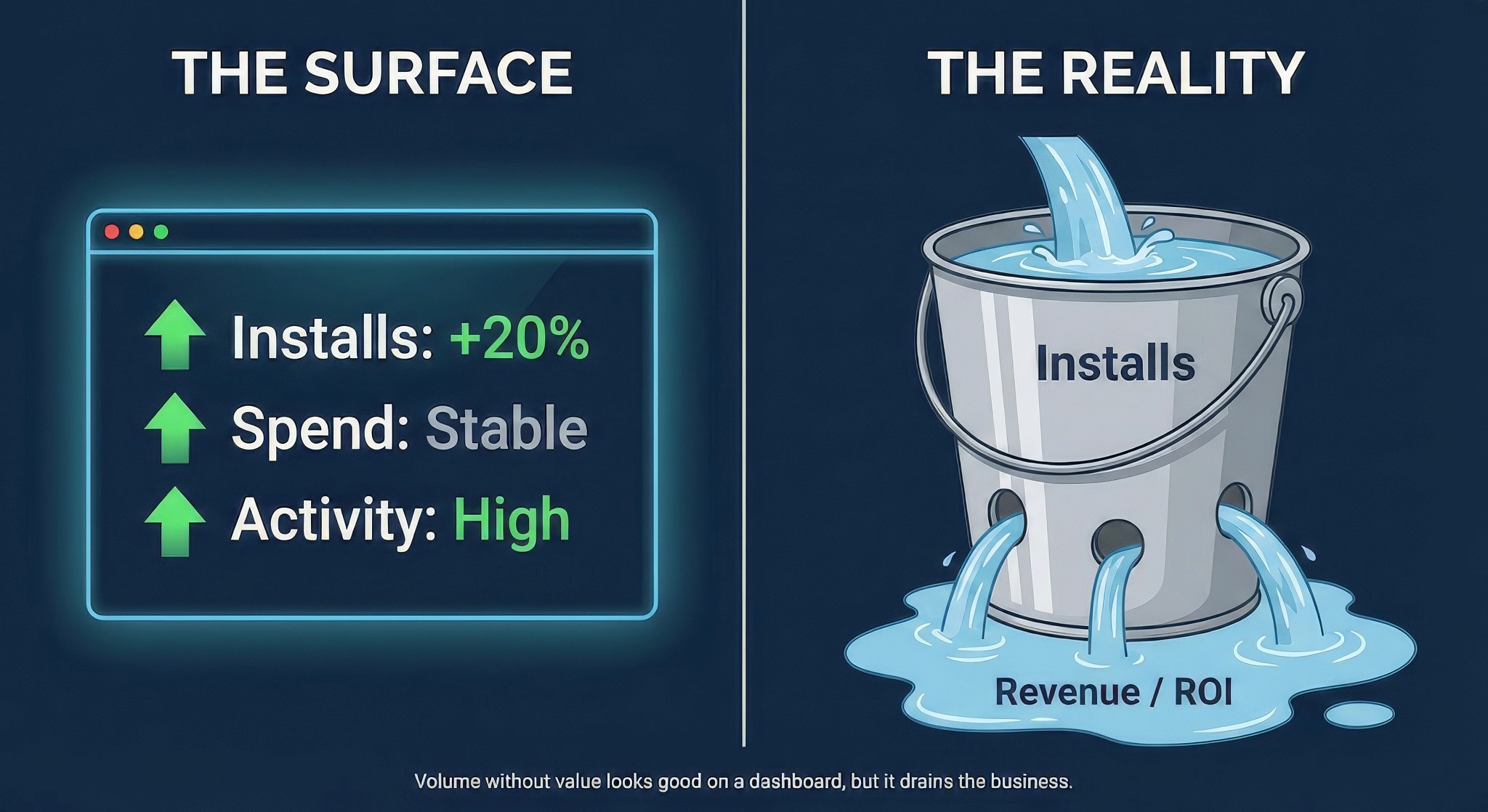
Meta campaigns were running. Spend was stable. Installs were coming in consistently.
Dashboards showed activity. Reports showed volume.
But the business wasn’t feeling it.
Revenue wasn’t scaling with spend.
Paying users weren’t increasing in proportion to acquisition.
Efficiency plateaued no matter how campaigns were optimized.
The problem wasn’t ad performance.
The problem was that the ad platform couldn’t see what actually mattered to the business.
Meta was optimizing for installs.
The business made money from paid sessions.
That misalignment was silently draining the budget.
This isn’t a story about better ads.
It’s about fixing the infrastructure that allows performance marketing to function as a growth engine instead of a traffic machine.
Here's what we fixed, why it mattered, and how it unlocked scalable growth without changing a single ad.
The Real Problem: Measurement Architecture, Not Media Buying
Most app teams treat measurement as a one-time setup:
Integrate an MMP → events fire → dashboards populate → move on.
But this is where the biggest structural mistake happens.
Events firing inside an MMP does not mean ad platforms can use them.
MMPs measure attribution and user behavior.
Ad platforms optimize based on signals they can receive, understand, and learn from.
Between those two sits a critical layer:
event mapping, schema alignment, and signal design.
In this case, key business events existed in the MMP.
But from Meta’s perspective, most users looked the same.
The platform couldn’t reliably distinguish between:
someone who installed and bounced
someone who paid and became a loyal customer
So it optimized for what it could see: installs.
Volume without value is just expensive traffic.
Problem 1: Events Existed, But the Ad Platform Couldn’t Use Them
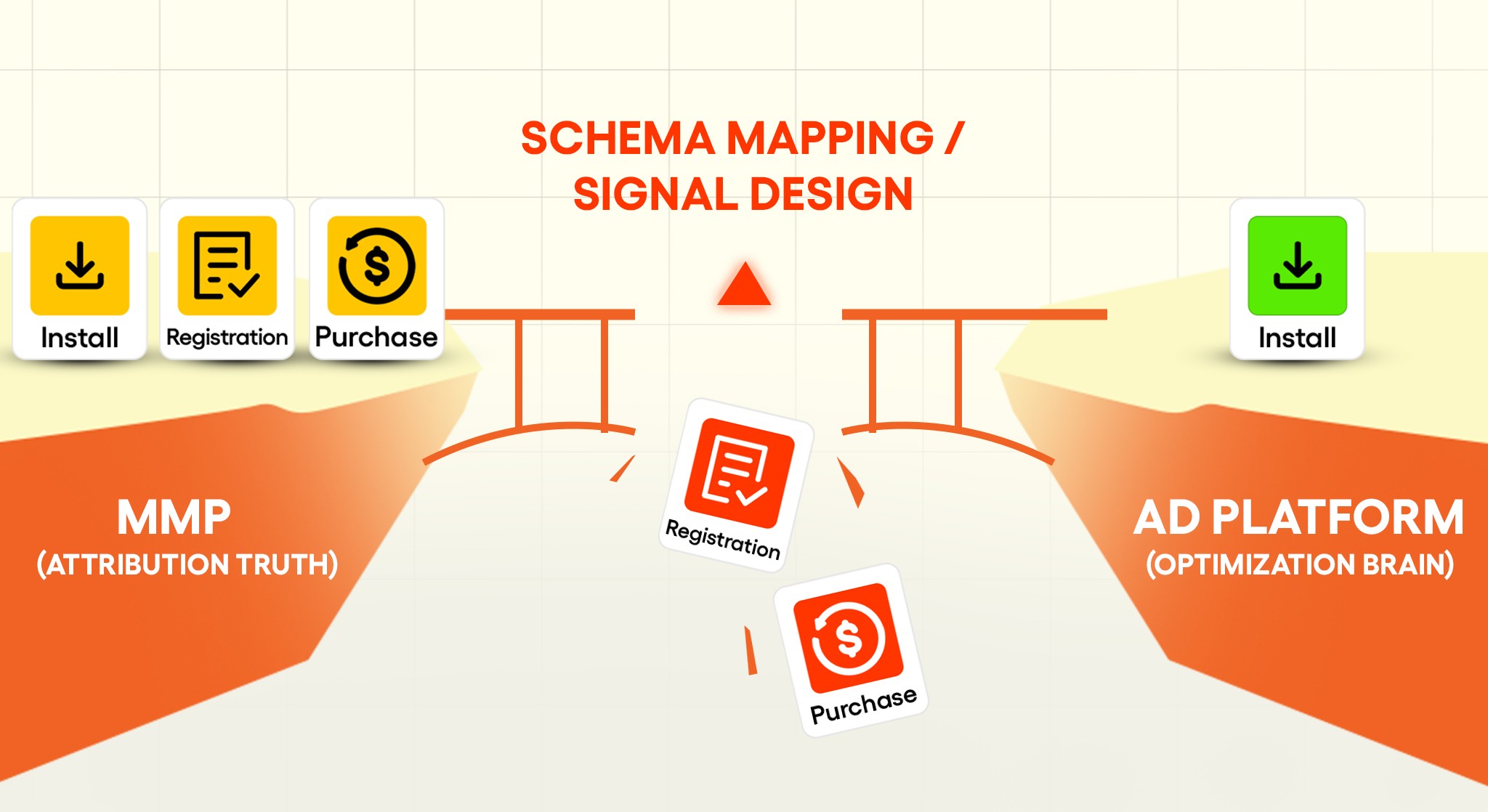
This is one of the biggest misconceptions in app marketing:
If the event exists in the MMP, the ad platform can optimize it.
Not true.
Events must be:
mapped correctly
structured in the platform’s required schema
eligible for optimization
The app’s key actions were being tracked internally but weren’t properly structured for Meta to use as optimization signals.
As a result, campaigns defaulted to install optimization, not because of strategy, but because the platform had no usable customer signal.
Problem 2: Old Event Schema, No Platform Compatibility
The issue wasn’t the absence of events.
It was that they were configured using an outdated SDK schema.
From Meta’s perspective, critical business actions effectively did not exist.
We rebuilt the event structure to align with the ad platform’s schema requirements, ensuring high-value actions could flow as usable optimization signals.
At the same time, we simplified the optimization strategy:
Instead of optimizing toward revenue or ROAS (which introduces cost data dependencies and extra complexity), we aligned campaigns around a core business outcome — payment success — as the primary conversion signal.
One strong signal beats multiple noisy ones.
Problem 3: iOS14+ Campaigns Could Only Optimize for Installs
When iOS14+ campaigns were launched, the platform only allowed optimization for installs.
No registration.
No payment.
No downstream actions.
This is where many teams blame:
creatives
targeting
Budget
But this wasn’t a media problem.
It was a SKAdNetwork problem.
Apple’s privacy framework changed how attribution works.
User-level events are no longer sent back to platforms. Instead, platforms receive aggregated postbacks through SKAdNetwork.
That shifts performance marketing from “tracking events” to designing signals.
Problem 4: SKAdNetwork Requires Signal Architecture
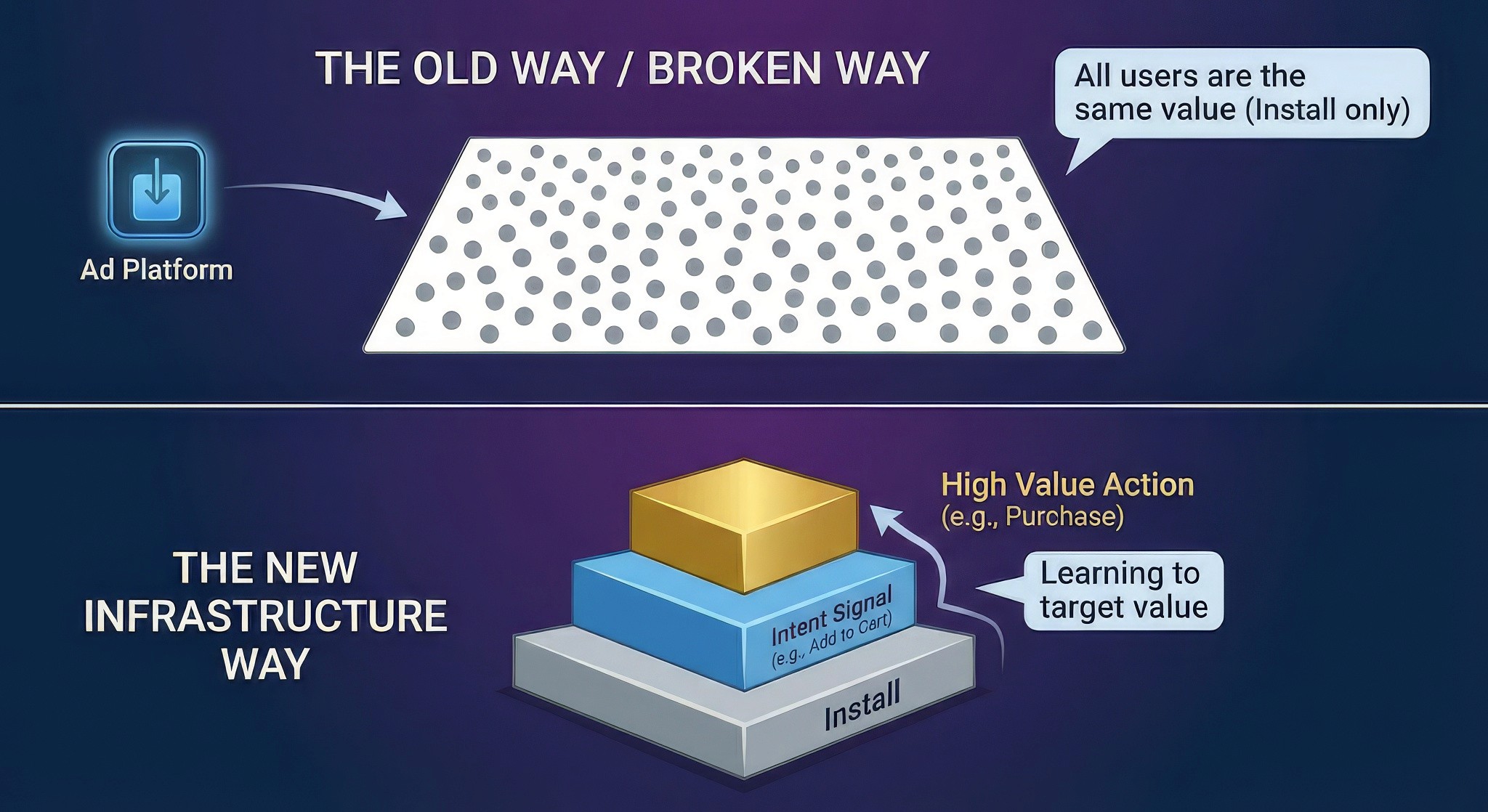
With SKAN, you are no longer just passing events.
You are designing a value hierarchy.
Inside the MMP, we rebuilt the SKAN conversion value architecture to reflect actual business value.
The structure followed a progression:
Early signals focused on purchase intent
Mid signals reflected deeper engagement and booking behavior
Late signals captured retention and repeat usage
Instead of Meta seeing “install or nothing,” it now received a structured progression of user value.
This gave the algorithm a machine-readable hierarchy:
Install → Intent → Payment → Retention
That hierarchy is what enables learning.
Problem 5: Without Hierarchy, There Is No Learning
Before the rebuild, the platform saw a flat world.
Afterward, it saw structure.
That allowed the algorithm to:
identify high-value users earlier
prioritize profitable acquisition
scale toward revenue-driving behavior rather than volume
This wasn’t creative optimization.
It was infrastructure engineering.
What Changed as a Result
This project did not involve:
new creatives
new audiences
new channels
It involved:
rebuilding event architecture
aligning MMP configuration with platform requirements
designing SKAN conversion values based on business value
restoring the signal pathway between user behavior and ad optimization
The outcome was not more installs.
It was campaigns that could finally optimize toward users who matter to the business.
The Bigger Lesson for App Teams
Performance marketing for apps is not media buying.
It is:
measurement architecture
MMP configuration
privacy-aware signal design
platform integration
Then ads.
If platforms cannot see who pays, they will optimize for who installs.
And no amount of creative testing, targeting adjustments, or budget scaling can fix that.
Fix the infrastructure first.
Everything else becomes optimization.