

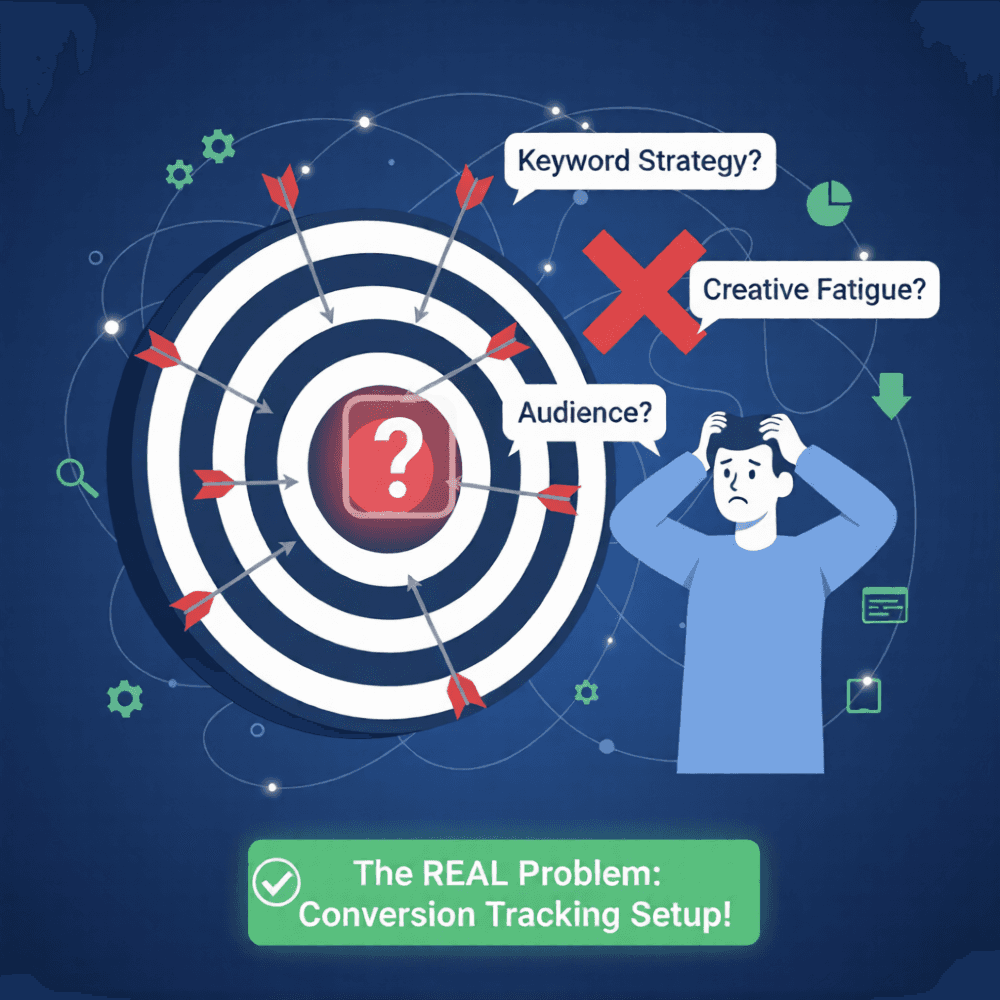
Most teams think their Google Ads problem is targeting.
It's not.
If your campaigns spend consistently but efficiency declines, the issue is almost never:
keyword strategy
audience selection
creative fatigue
It's the conversion tracking setup you're feeding the algorithm.
We audited a service business with stable Google Ads spend and consistent conversion volume. Dashboards showed green. Reports showed activity.
But the business wasn't growing.
Real inquiries were down 40% year-over-year.
Cost per actual lead had doubled.
Revenue wasn't scaling with ad spend.
The problem wasn't ad performance or bidding strategy.
The problem was that Google Ads was optimizing for page views while the business made money from service inquiries.
That misalignment was silently destroying efficiency through poor conversion signal architecture.
This isn't about better ad copy. It's about fixing the conversion hierarchy that allows paid search to function as a growth engine instead of a traffic machine.
The Real Problem: Conversion Signal Architecture, Not Media Buying
Most teams treat Google Ads conversion tracking as a setup task:
Install Google Tag Manager → fire conversion events → mark conversions → move on.
But this is where the biggest strategic mistake happens.
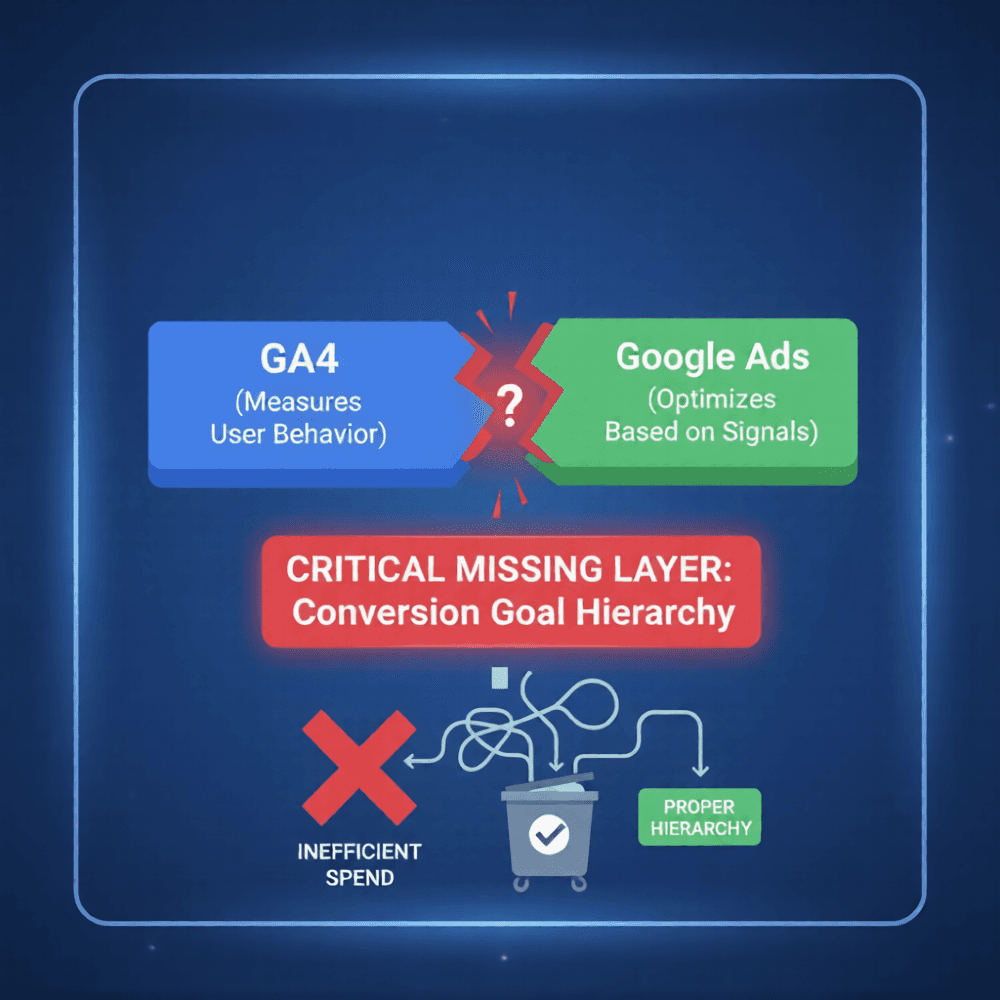
Events firing in GA4 does not mean Google Ads can use them for optimization.
GA4 measures user behavior across your site. Google Ads optimizes based on conversion signals it can learn from and use for smart bidding.
Between those two sits a critical layer: conversion goal hierarchy.
In this case, the business tracked everything:
Page views
Button clicks
Scroll depth
Form submissions
Phone calls
All marked as "primary" conversions in the Google Ads conversion action settings.
From the platform's perspective, every action looked equally valuable.
The algorithm couldn't distinguish between someone who viewed a page and left versus someone who submitted a high-intent service inquiry.
So it optimized for what it could find most of: page views.
Volume without value is just expensive traffic.
This is the core issue with improper conversion value optimization.
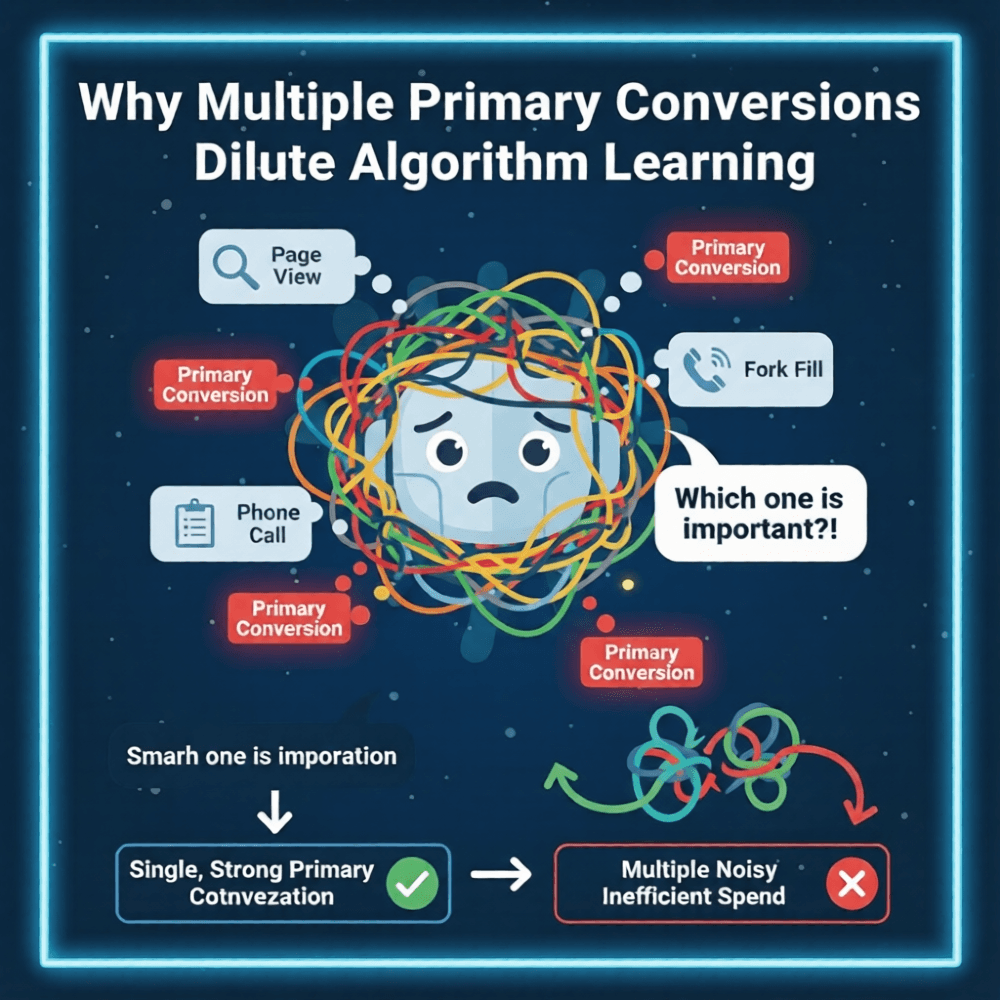
Why Multiple Primary Conversions Dilute Algorithm Learning
This is one of the biggest misconceptions about conversion tracking:
"If we track more conversions in Google Ads, the algorithm has more data to optimize."
Not true.
Multiple primary conversions dilute the learning signal.
When you tell Google Ads that 8 different conversion actions are all equally important, the platform doesn't get smarter—it gets confused about your actual business objectives.
The business had:
5 different conversion goals marked as "Primary"
No secondary conversion structure for micro-conversions
Inconsistent conversion settings between campaign and account level
Campaign A optimized toward form fills.
Campaign B optimized toward page views.
Campaign C optimized toward phone call conversions.
Google's smart bidding algorithms (Target CPA, Target ROAS, Maximize Conversions) couldn't build a coherent learning model because every campaign taught it something different about what "success" means.
This prevents effective value-based bidding and breaks attribution modeling.
One strong primary conversion beats multiple noisy conversion signals.
How Misaligned Goals Inflate Vanity Metrics
The most dangerous part wasn't just algorithmic confusion.
It was that performance looked good on surface-level metrics.
Total conversion volume was up.
Cost per conversion was down.
But those conversions weren't the ones that mattered to revenue.
The algorithm had optimized itself into a local maximum through poor conversion value setup:
Page view conversions: ↑ 120%
Service inquiry conversions: ↓ 40%
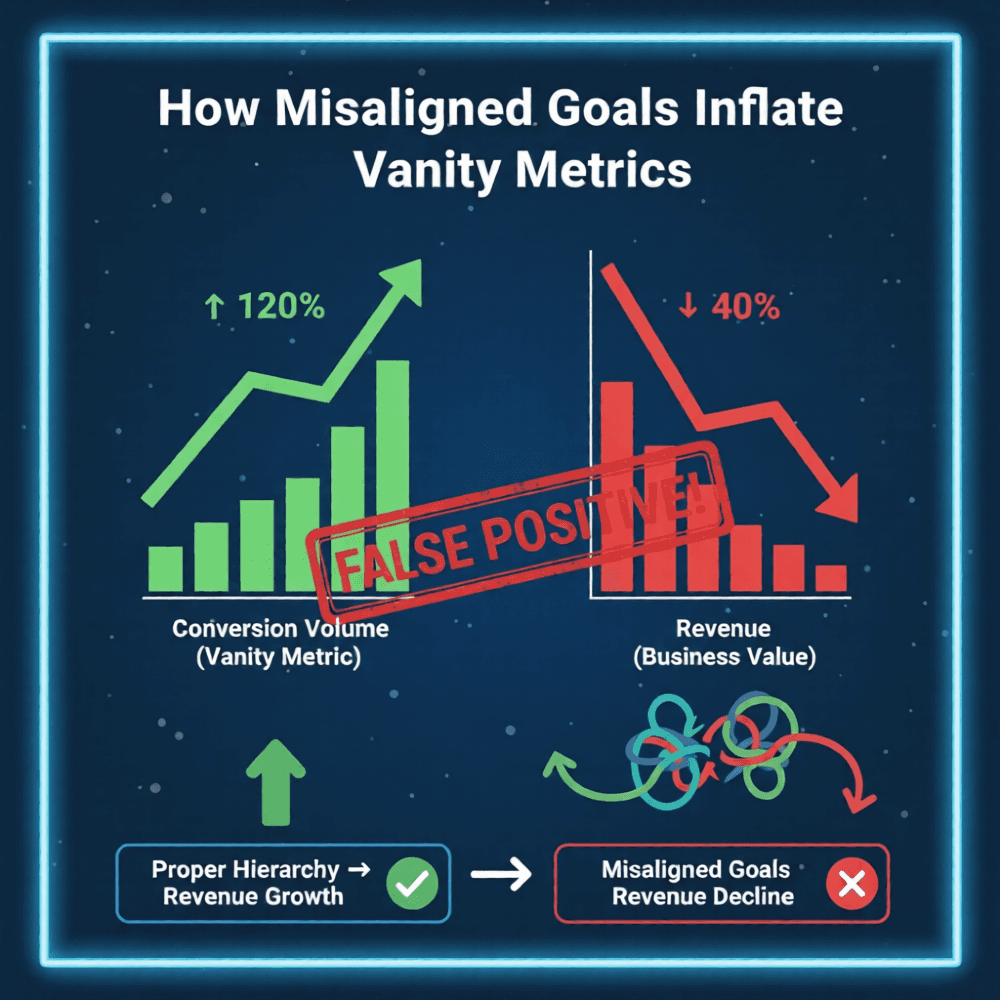
Dashboards showed "success" based on conversion count.
The business was bleeding revenue based on conversion value.
This is why conversion hierarchy and proper conversion action configuration matters more than campaign tactics, audience targeting, or bidding strategies.
If Google Ads can't see what drives business value through proper conversion tracking, it will optimize for what's easy to find.
Campaign Structure: When Overlap Prevents Optimization
The conversion signal problem was compounded by campaign architecture issues.
Multiple campaigns were built around the same user intent but with different conversion goals and optimization objectives:
Ceramic Coating campaign → optimizing for form fill conversions
Paint Protection campaign → optimizing for page view conversions
Detailing Services campaign → optimizing for call conversions
All three campaigns targeted overlapping broad match keywords without proper negative keyword lists.
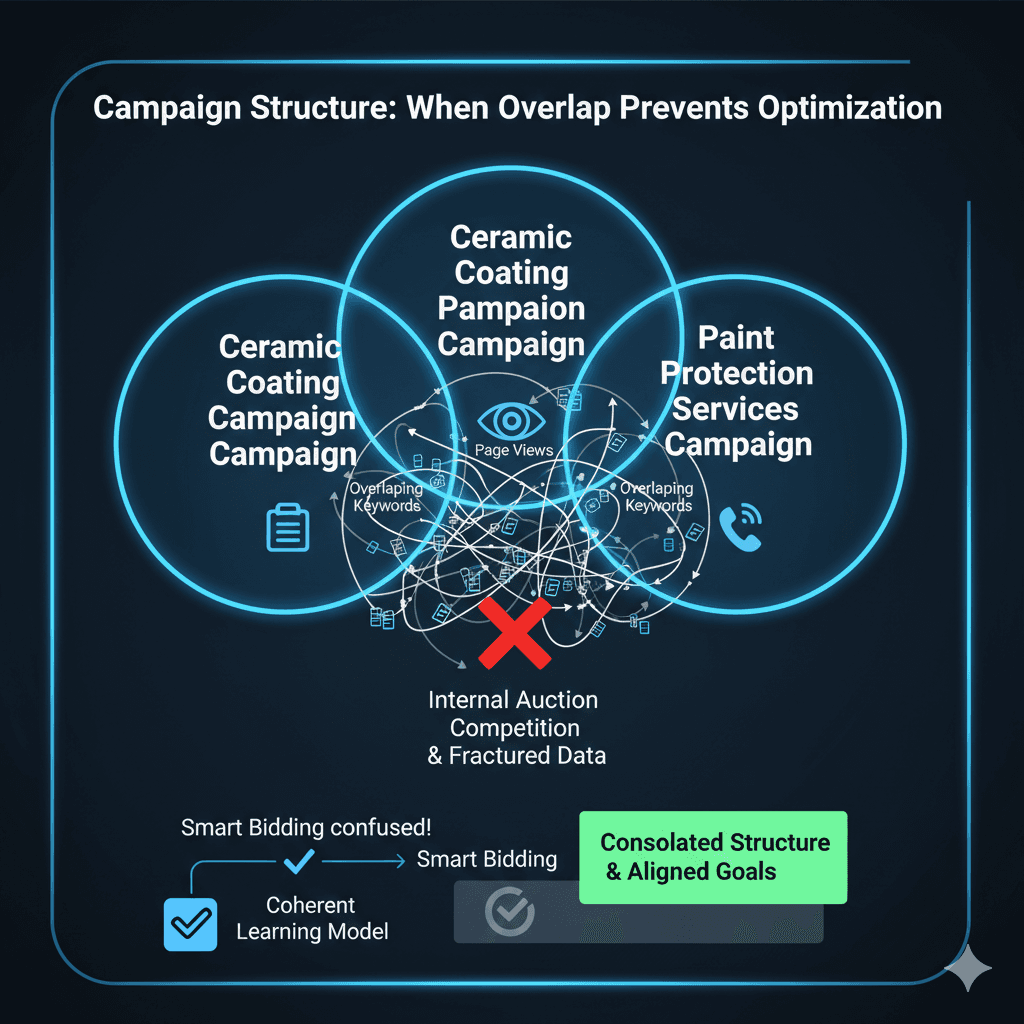
The result from this flawed Google Ads conversion tracking setup:
Internal auction competition drove up cost per click (CPC)
Each campaign received fractured data signals for machine learning
Smart bidding couldn't learn what "success" looked like because every campaign defined it differently through misaligned conversion settings
No amount of bid adjustments, keyword refinement, or enhanced conversions can fix structural campaign problems.
The architecture itself was preventing algorithmic optimization.
Over-Aggressive Negative Keywords Block Intent Signals
On top of conversion tracking misalignment, the account had another hidden blocker affecting conversion optimization:
Over-aggressive negative keyword lists implemented using broad match modifiers.
99% of excluded search terms used broad match negatives, which meant high-intent queries were systematically blocked:
"auto" → blocked "auto detailing near me"
"garage" → blocked "ceramic coating garage"
Brand names → blocked "Audi service center"
High-intent search queries were being excluded because someone saw one irrelevant click and panic-added a broad negative keyword without considering conversion tracking implications.
This is the paid search equivalent of throwing the baby out with the bathwater.
You can't optimize conversion campaigns or run effective smart bidding when you don't allow Google Ads to see high-value user signals.
Negative keywords should be surgical using exact and phrase match, not scorched earth using broad match.
What We Fixed in the Google Ads Conversion Tracking Setup
This conversion tracking optimization project did not involve:
New ad creative or responsive search ads
New landing pages or conversion rate optimization
New targeting strategies or audience segmentation
It involved rebuilding the conversion signal architecture:
1. Rebuilt Conversion Goal Hierarchy
One primary conversion: service inquiries (the action that drives revenue)
Secondary conversions: engagement signals like page views, video watches
Clear conversion value weighting in Google Ads based on average order value
Implemented offline conversion tracking for closed deals via CRM integration
This aligned with Google's enhanced conversions and conversion modeling best practices.
2. Consolidated Campaign Structure
Reduced overlapping campaigns competing for identical search traffic
Aligned all campaigns to optimize toward the same primary conversion action
Created distinct campaigns for brand vs. non-brand with separate conversion strategies
Gave the algorithm clean, consistent data signals for target CPA bidding
3. Refined Negative Keyword Strategy
Removed 60% of broad match negative keywords that blocked intent
Implemented exact match and phrase match exclusions only
Restored visibility to high-intent queries systematically excluded
Set up search term reports monitoring for ongoing optimization
4. Implemented Conversion Value Optimization
Not all inquiries are equal; service type determines lifetime value (LTV)
Assigned conversion values based on historical close rates and average transaction value
Enabled target ROAS bidding instead of target CPA
Let the algorithm optimize for revenue, not just conversion volume
The outcome wasn't more total conversions.
It was campaigns optimized toward users who actually matter to business growth through proper conversion tracking.
Results Within 45 Days:
Cost per service inquiry: ↓ 38%
Inquiry conversion volume: ↑ 27%
Revenue per dollar spent (ROAS): ↑ 52%
Same budget allocation. Same market conditions. Different conversion signal infrastructure.
The Bigger Lesson for Google Ads Performance Teams
Paid search success isn't media buying or creative optimization.
It's:
Conversion signal architecture through proper tracking setup
Campaign structure design that prevents signal dilution
Goal hierarchy alignment between business KPIs and platform optimization
Smart bidding configuration based on clean conversion data
Then ads, keywords, and targeting.
If Google Ads can't see what drives revenue through proper conversion tracking, it will optimize for what's visible in the conversion data.
And no amount of keyword research, bid adjustments, enhanced conversions, or creative testing can fix broken conversion tracking infrastructure.
Fix the Google Ads conversion tracking architecture first.
Everything else becomes optimization.